Ice Maker Not Making Ice? What to Check Before Calling for Repair
Separate missing ice from a dispenser problem, record model-specific symptoms, and plan ice maker repair in Orange County.
Quick answer: identify whether ice is missing or simply not dispensing
An empty ice bin, slow production, and a full bin that will not dispense are different complaints. Check the normal ice-maker setting, look for a displayed warning, and consult the instructions for your exact model. If the refrigerator is also losing cooling, report that first: replacing an ice maker without diagnosing the cooling problem may not address the cause.
Keep fingers and tools away from moving ice-maker parts. Do not force a frozen assembly, bypass a door switch, or use a hair dryer inside the appliance. If there is leaking water near electrical equipment, stop using the affected appliance and arrange professional assessment. This guide is for preparing a useful service request, not for opening electrical or refrigerant systems.
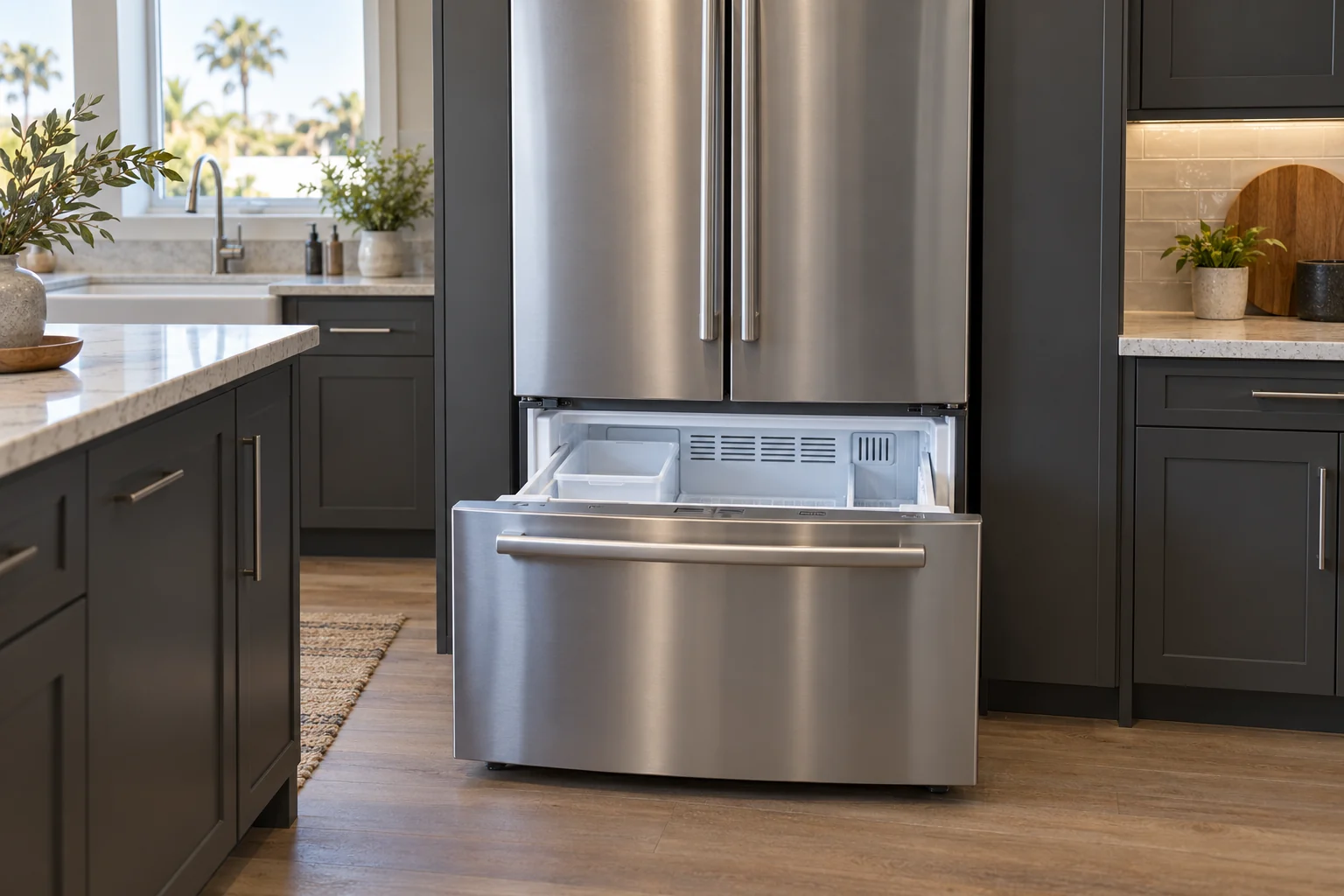
An empty ice bin is different from a dispenser problem
Start with the simplest description: is there actually ice in the storage bin? A refrigerator can have ice available while the dispenser fails to deliver it. Conversely, a working dispenser motor cannot supply cubes that were never produced. Tell the technician which condition you observed without reaching into the mechanism. A photo of the bin, taken with the appliance in a normal safe state, can communicate more than the general phrase “the ice is broken.”
Also distinguish reduced production from a complete stop. Did your usual household use empty the bin, or has it remained empty even when no one is taking ice? Note when you last saw a normal batch. If there are two ice systems, identify the one involved: an in-door unit and a separate freezer ice maker need not share the same complaint. Do not assume a repair recommended for one assembly applies to every ice-related function on the refrigerator.
Begin with the model, not a replacement part listing
Photograph the model label if it is normally accessible without moving or dismantling the refrigerator. Include the complete model number rather than only the brand or an approximate capacity. Similar-looking refrigerators can use different ice systems, controls, filters, and service procedures. A marketplace listing that mentions your brand does not establish compatibility with your appliance. Keep any existing warranty paperwork available as well; eligibility is checked against the actual equipment and coverage terms.
For a built-in installation, mention the cabinetry and whether a panel conceals the refrigerator front. Do not remove decorative panels or pull the appliance out to improve your description. A normal photo of the kitchen arrangement is enough to begin planning access. If the refrigerator serves a rental property, tell us who can provide entry and who will approve work. These details help organize the visit without pretending that a model number alone reveals the failed component.
Check ordinary settings using your own manufacturer's instructions
Review the user controls for the affected ice maker. An ice-off setting is different from a hardware failure, but button names and control sequences vary. Do not copy a reset procedure just because the refrigerator in a video has the same brand badge. LG's support guide, for example, discusses ice settings, freezer conditions, water supply, and the time needed after installation. Those are useful categories to consider, not a universal sequence for every refrigerator.
If you change an ordinary setting according to your manual, write down what you changed and when. Avoid making several unrelated changes at once. A clear timeline helps separate a continuing fault from an observation made before the machine had an opportunity to respond. You do not need to keep experimenting until the visit. If the instructions do not match your display, stop there and send a photo of the controls with your request.
Manufacturer reference: LG: ice maker not making ice or not making enough. Follow the manual for your particular model and installation.
Describe water and ice symptoms separately
If the refrigerator has a water dispenser, tell us whether it is operating normally, producing a reduced stream, or not dispensing. That information gives the technician context, but it does not prove that the ice-making circuit is receiving the water it needs. Avoid conclusions such as “the water valve must be good because drinking water works.” Report what you can observe and let the service assessment establish which parts of the system are functioning.
Include the date of a recent filter change and the exact filter used, if known. Explain whether the complaint appeared before or after the change. Do not loosen water connections, disconnect tubing, or move a heavy refrigerator to inspect the rear. A recent plumbing visit, water shutoff, or refrigerator installation is worth mentioning even when the timing might be coincidental. The purpose is to supply a complete history, not to blame a particular installer without evidence.
Report cooling changes before focusing on the ice maker
Tell the service provider if food storage conditions have changed along with the ice complaint. Examples include food becoming softer than usual, an unexpected temperature warning, or a compartment that feels warmer. A control-panel setting is not the same as an independently measured compartment temperature. If you already have a safe, routine thermometer reading, record it with the time and location. Do not dismantle a panel to reach a sensor or create a test condition.
When cooling is the broader concern, use our refrigerator not cooling guide to organize the additional observations. Keep door openings brief and make appropriate arrangements for food whose storage temperature is uncertain. This article does not assess food safety from a screenshot or a display number. A refrigerator diagnosis should address the full complaint rather than treating an empty ice bin as proof that the ice maker itself needs replacement.
What changed before the ice stopped?
Build a short timeline: last normal operation, first unusual behavior, and anything that happened between them. Relevant events might include delivery, a household move, filter replacement, cleaning, a power interruption, or a change in household ice use. State whether the problem was sudden or gradually became noticeable. If the machine has worked intermittently, give the dates you remember rather than rounding every occurrence into a continuous failure.
Be equally clear about what you did not observe. “We returned from a trip and found the bin empty” contains less timing information than “it stopped producing yesterday,” but it is still useful and honest. The technician can interpret the available history. An invented start date can send the discussion in the wrong direction. Save any warning-message photo before dismissing a normal notification, and keep prior service records if the same symptom has been investigated before.
Sounds and warnings are clues, not a diagnosis
Describe a noise in relation to what the appliance was doing: during a dispensing attempt, with the door closed, or at an apparently unrelated time. If you already have a recording made safely, include it. Do not deliberately hold switches, remove guards, or reach into a moving mechanism to reproduce a sound. A repeated knock, brief hum, and a silent machine are different observations, but none identifies a replacement part on its own.
Write an error code exactly as displayed, including letters, punctuation, and the affected compartment if shown. “An ice error” is less useful than a readable display photo. The same applies to a smart-app notification: keep the actual wording, while recognizing that an app message is not the complete service diagnosis. A manufacturer-specific warning should be interpreted for the exact model and the conditions in which it appeared.
What to leave for professional diagnosis
Internal wiring, energized measurements, water-valve testing, and sealed-system work belong in a qualified service assessment. Do not order a control board or ice assembly solely because an online discussion describes a similar symptom. Even an accurate account of another repair does not show what failed in your refrigerator. The useful first decision is whether the appliance needs diagnosis, not which part can be purchased fastest.
Avoid force and improvised thawing. A frozen-looking area is not permission to pry components apart or apply intense heat. Ask the provider how to leave the appliance before the appointment; changing its condition can affect what is available to inspect. If you have already turned it off or followed a manufacturer instruction, explain exactly what happened. The goal is a safe, interpretable starting point, not preserving a fault at the expense of your household's needs.
What the repair recommendation should explain
After assessment, ask how the findings relate to the complaint you reported. Is the proposed work intended to restore production, dispensing, or a broader refrigerator function? You do not need to understand every test instrument to ask that question. The estimate should describe the work being recommended and distinguish it from unrelated observations. If further investigation is needed, ask what remains uncertain before approving a part order.
Parts availability and access can affect the next step. A diagnosis does not automatically promise that every repair can be finished during the first appointment. Confirm whether a component must be ordered and how a return visit would be coordinated. For an integrated refrigerator, discuss access to cabinetry and the surrounding space. Keep the assessment tied to the actual machine rather than comparing a complete repair proposal with the price of an unverified component online.
Diagnostic fee, authorization, and warranty questions
Profe Fix's diagnostic fee is $95, waived with a completed repair. It is not a flat price for replacing any ice maker. The proposed repair cost is explained after diagnosis, before you approve the work. If you decide not to proceed, clarify the diagnostic charge under the appointment terms. Our Orange County appliance repair cost guide explains how to compare a visit fee with a complete repair scope.
Eligible repairs include a 90-day parts and labor warranty. Ask what is covered for the particular work and retain the invoice and service date. An existing manufacturer's warranty or another service plan may have separate requirements; confirm those before arranging an independent repair if relevant. A future symptom still needs assessment rather than an assumption that every refrigerator issue is included in one previous repair's coverage.
Repair or replacement should be a model-specific decision
An ice complaint does not automatically make a refrigerator uneconomical to keep. Consider the diagnosed scope, overall condition, previous repairs, and your plans for the kitchen. For a built-in machine, a replacement discussion should include fit and installation rather than comparing the repair with the cheapest freestanding refrigerator. Conversely, an expensive-looking appliance does not make every possible repair worthwhile. You need the actual proposal before evaluating the tradeoff.
Our repair-or-replace guide offers a framework for that decision. Separate the inconvenience of temporarily buying ice from the condition and cost of the whole appliance. If other faults are already known, discuss them openly. A decision made from the full picture is more useful than one driven by a guess that a small visible symptom must imply either a very small repair or a complete refrigerator replacement.
Request ice maker repair in Orange County
A useful request includes your city or ZIP code, brand, model if available, whether ice is being produced, whether it dispenses, and any change in cooling. Add the approximate start date and recent filter or plumbing work. Mention built-in panels, tight installation spaces, or access requirements. This information helps us discuss the visit; it does not replace diagnosis or automatically reserve an appointment.
Use our ice maker repair service page for the next step. If both ice production and refrigerator cooling are affected, also mention that when requesting refrigerator repair in Orange County. Profe Fix confirms service suitability and availability for the actual appliance and address. You should receive a clear plan for assessment and a repair proposal to approve, rather than a promise based only on the words “no ice.”
Questions homeowners often ask
Does an ice maker problem mean the compressor failed?
No. Missing ice alone does not establish a compressor diagnosis. Report any changes in compartment cooling so the technician can assess the relationship rather than assuming that one symptom identifies a sealed-system fault.
Can I send a photo instead of the model number?
A label photo is ideal when safely accessible. A photo of the refrigerator and controls can also help describe the installation. Do not move a heavy unit to obtain a label; tell us what information is available.
Should I reset the refrigerator before calling?
Follow only the instructions for your model, and preserve any warning photo first. Do not repeatedly reset it in search of a temporary change. Describe any reset already performed so the technician has an accurate history.
Additional manufacturer reference: GE Appliances: refrigerator and freezer support. The article image is a topic illustration, not a photograph of a completed Profe Fix repair.